

Amblyopia
What Is Amblyopia?

How Does Amblyopia Develop?
-
Strabismic amblyopia
This occurs when the eyes are not properly aligned. To avoid double vision (diplopia), the brain “suppresses” the image from the deviating eye. -
Deprivation amblyopia
Visual input is reduced or blurred because something obstructs normal vision, such as a congenital cataract or ptosis (drooping eyelid). It can affect one or both eyes. -
Refractive amblyopia
This occurs when there is a significant or unequal refractive error between the two eyes (anisometropia), or high refractive error in both eyes (myopia, hyperopia, astigmatism). The brain “prefers” the eye that sees more clearly.
What Are the Symptoms of Amblyopia?
- Squinting or tilting the head when focusing
- Difficulty reaching for or following objects
- Holding objects very close to see or read
- Complaining of poor vision in one eye
How Is Amblyopia Diagnosed?
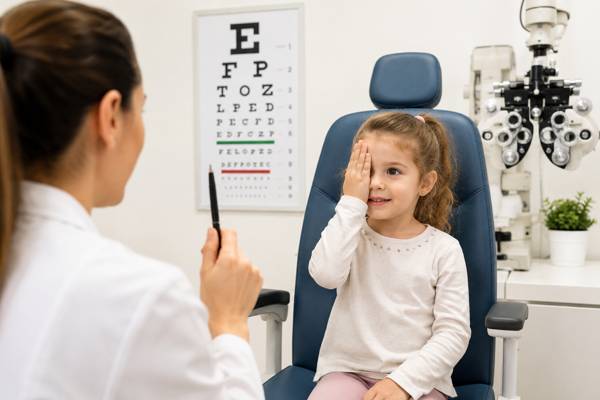
- Measurement of visual acuity and refractive error
- Assessment of eye alignment and coordination
- Assessment of visual function and stereopsis (depth perception)
Treatment Options for Amblyopia
1. Restoring a Clear Visual Image
2. Patching (Occlusion) of the Better Eye
3. Modern Binocular Treatment: Digital Therapeutics
Important limitation: who is not a suitable candidate?
All digital dichoptic systems, such as CureSight, Luminopia One, Vivid Vision and AmblyoPlay, rely on the principle of binocular fusion. They require the brain to combine two different images, one from each eye, into a single visual percept. For this reason, the method is indicated only for patients with amblyopia due to anisometropia or mild strabismus with a small angle of deviation, usually up to 8 prism diopters.
In patients with large-angle strabismus, the necessary binocular fusion is not achievable, because the two images do not fall on corresponding points of the two retinas. Consequently, digital dichoptic therapies are not effective in these patients. In such cases, treatment should follow the classic approach: first surgical correction of the strabismus, to reduce the angle of deviation to acceptable levels, followed by conventional patching or, after surgical correction, a trial of digital dichoptic therapy.
The regulatory clearances for CureSight and Luminopia One reflect this limitation, as they apply to amblyopia associated with anisometropia and/or mild strabismus.
Current digital systems for amblyopia treatment
CureSight is cleared by the US FDA (2022) for children aged 4–9 with amblyopia associated with anisometropia and/or mild strabismus. The child wears special red-blue anaglyph glasses and watches regular content of their choice, available through streaming services such as Netflix and YouTube, on a dedicated tablet screen. CureSight’s main technological innovation is its built-in real-time eye tracking. The device continuously tracks the position of the eyes and selectively blurs only the central (macular) region of the better eye, leaving peripheral vision clear. The brain is thus forced to use the amblyopia-affected eye for central vision, while binocular cooperation is maintained and strengthened. In the pivotal multicenter trial, CureSight was shown to be non-inferior to conventional patching. The recommended use is about 90 minutes per day, 5 days per week.
Luminopia One was the first digital therapeutic for amblyopia to receive US FDA authorization (2021), for children aged 4–7. In everyday practice, it is also used off-label in older children. It uses a virtual reality (VR) headset through which the child watches content from a library of more than 75 series and 3,000 episodes of popular children’s programs. The software reduces the contrast of the image seen by the dominant eye and “blocks out” complementary areas of the image in each eye, so that the brain has to combine the two images into a single visual percept. The recommended use is one hour per day, 6 days per week, for at least 12 weeks. Its efficacy was documented in a randomized, multicenter, phase 3 trial.
Vivid Vision is a well-established virtual-reality dichoptic therapy program that is CE-marked and FDA-registered. It runs on commercially available VR headsets and offers a library of binocular stimulation games designed for children aged 5 and older, as well as adults. Each eye sees different elements of the virtual scene, which the patient must combine in order to play, training visual acuity, stereopsis and binocular cooperation at the same time. It is available in two versions: one for professional use in the clinic (Vivid Vision Office) and one for home use (Vivid Vision Home), under the supervision of an ophthalmologist.
AmblyoPlay
AmblyoPlay is a digital dichoptic visual training program of European origin, widely available by subscription throughout Europe, including Greece. It combines red-blue anaglyph glasses with a tablet or computer application that includes gamified exercises of about 30 minutes per day. AmblyoPlay is not currently certified as a medical device (CE) for the treatment of amblyopia, but is marketed as a visual-training wellness tool. A recently published pilot study showed promising results in children with anisometropic amblyopia, and its wide availability in Europe and lower cost make it a practical, affordable adjunct to conventional treatment.
Binocular games
Alongside these commercial systems, a number of specially designed binocular video games, such as Dig Rush, Falling Blocks and Tetris-based games, have been studied in PEDIG clinical trials and by European research groups. They work on the same principle of dichoptic stimulation: each eye sees different elements of the game, which must be combined in order to play. Some of them are freely available as research tools or through specialized platforms.
Availability in the European Union and Greece
Advantages of the binocular approach
Digital binocular systems offer three important advantages over traditional patching:
- Better adherence. Instead of wearing an annoying patch, the child can play or watch favorite content.
- Direct targeting of binocular suppression, which patching bypasses. The aim is to improve not only visual acuity but also stereopsis and binocular cooperation.
- Objective monitoring of use (compliance tracking) through the device.
Up to What Age Can Amblyopia Be Treated, and What About Adults?
Treatment of amblyopia is more effective the earlier it is started and completed. The classic recommendation is to complete treatment before the age of 8–9, when the visual cortex becomes more stable. However, more recent PEDIG studies have shown that a significant proportion of children and adolescents up to 17 years of age may respond to treatment, particularly when modern binocular methods are used.
For “lazy eye” in adults, the potential for improvement depends on the cause and severity of the amblyopia, the patient’s age and the characteristics of their binocular vision. Management should be individualized, following a comprehensive eye examination. Full restoration of visual acuity to 20/20 (10/10) is not always achievable. The realistic goal is the maximum possible improvement in visual acuity and binocular cooperation, based on the cause and severity of the amblyopia.
Can Amblyopia Be Prevented?
- A first preventive eye examination between ages 3 and 4
- Regular follow-up examinations, especially if there is a family history of strabismus or refractive errors
- Prompt evaluation of any unusual visual behavior (e.g., head tilting, closing one eye)

Frequently Asked Questions
The decision to patch the better eye must be made by the ophthalmologist, with the aim of training the whole visual system and improving the visual acuity of the amblyopic eye, whether or not strabismus is present. Continuous monitoring by a qualified ophthalmologist is essential, both to check how well patching is working and to avoid causing amblyopia in the dominant, normal eye.
Treating amblyopia depends on the adaptability (plasticity) of the visual system. Once the brain “matures,” it no longer responds satisfactorily to treatment. Treatment should ideally be completed by the age of 8–9 years. However, the most recent large study funded by the US National Institutes of Health (NIH) showed that at least some patients up to the age of 17 respond to treatment with patching.
Treatment must be individualized for each case. Modern studies have given ophthalmologists clear guidelines on the duration and frequency of patching according to age and the severity of the amblyopia. Two hours of patching per day have been shown to be sufficient provided the amblyopia is not severe and the patient is between 3 and 7 years old. An absolute requirement is active use of the visual system during these hours (drawing, playing, reading, etc.). Part-time patching on weekends only can be sufficient in cases that have already responded to treatment.
Yes. In selected cases, atropine drops in the better eye (penalization) can be used instead of patching, and digital dichoptic (binocular) therapies are available for suitable patients, as described above. Parents should, however, be careful with another category of offerings.
Beware of “vision training programs” from non-ophthalmic centers. In recent years, a growing ecosystem of non-ophthalmic providers has emerged in Greece and internationally: optometrists specializing in “behavioral optometry,” private “vision training” centers and “visual gymnastics” agencies. They widely promote extensive and expensive programs of visual exercises (known as “vision therapy,” “behavioral vision therapy” or “visual training”), promising to address an extremely broad range of conditions: dyslexia, learning difficulties, ADHD, reading difficulties, poor school performance, attention disorders, athletic performance, and even “syndromes” such as convergence insufficiency offered as a catch-all explanation for any difficulty. In most cases these are commercial packages of dozens of sessions, at considerable cost and without transparent measures of therapeutic outcome.
The position of the leading international pediatric and ophthalmology organizations is clear and unequivocal. It is set out in a joint statement by the American Academy of Pediatrics (AAP), the American Academy of Ophthalmology (AAO), the American Association for Pediatric Ophthalmology and Strabismus (AAPOS) and the American Association of Certified Orthoptists (first issued in 2009 and reaffirmed since). According to this statement, there is no scientific evidence that eye exercises (vision therapy) or special colored lenses are effective in treating learning disabilities such as dyslexia. Dyslexia is a language-based neurodevelopmental disorder, not a visual one. ADHD is a neurodevelopmental disorder, not a visual one. Poor school performance has multiple causes (cognitive, educational, psychosocial) that need to be assessed by the appropriate professionals (pediatrician, child psychologist, speech-language therapist, special educator), not treated with eye exercises.
The scientific community regards behavioral vision therapy, when applied to the above indications, as lacking scientific support (pseudoscience). The best-established condition that benefits from visual exercises is symptomatic convergence insufficiency, and even then only with specific, specialized orthoptic protocols. Furthermore, despite advertising claims, there is no scientific evidence that “visual system training” slows the progression of myopia (the Tracksight method is not yet certified), or that it improves athletic performance in various sports.
At Athens Vision, we apply only therapeutic approaches with an established scientific basis, CE-marked where applicable and accepted by the ophthalmology community. When a patient comes to us with a history of participation in a “vision therapy” program from a non-ophthalmic provider, our recommendation is almost always the same: a systematic reassessment of the real cause of the problem and referral to the appropriate specialists (pediatrician, developmental specialist, speech-language therapist, child psychologist, special educator, or eye-movement assessment with the Greek eyeRADAR method), depending on the actual findings. We advise all parents to be especially cautious when they are offered a “treatment” that promises to correct refractive errors, learning difficulties, ADHD and athletic performance all at once. Such broad promises usually reflect misleading practices or, at best, approaches with no scientific foundation (pseudoscience).
Correcting strabismus (if present) is not a direct treatment for amblyopia. On the other hand, aligning the eyes is a basic prerequisite for improving binocular cooperation and binocular vision, which are always affected in amblyopia. For this reason, when strabismus and amblyopia coexist, surgical correction of the strabismus may be needed, along with continuous follow-up.
Restoring vision to 20/20 (10/10) is not always possible in amblyopia treatment. In general, treatment should continue for as long as it is effective. This usually means patching for several months and sustained effort on the part of the parents. When a young child cooperates poorly, we recommend a temporary pause in treatment, which often allows the child to cooperate much better later. If treatment proves ineffective despite all this, usually because of age, discontinuing it is recommended.
A doctor who specializes in this condition

Anastasios Charonis
Specialties
Corneal Surgery – Transplants, Cataracts, Refractive Surgery, Pediatric Ophthalmology, Strabismus
Maria Zozolou
Medical Degree, University of Athens Medical School; Ph.D., University of Athens Medical School; Board Certified by the European Board of Ophthalmology
Specialties
Pediatric Ophthalmology, Cataracts