

Children and Eyeglasses
Children and Eyeglasses
Children and eyeglasses: a combination that often plays a decisive role in the healthy development of vision
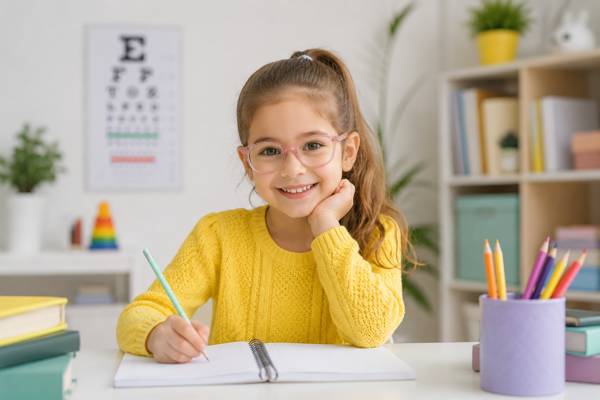
Why might a child need glasses?
- Refractive errors such as myopia (nearsightedness), hyperopia (farsightedness) or astigmatism
- Amblyopia (“lazy eye”) or strabismus (misaligned eyes)
- Protection of the visual system when one eye has reduced vision
- Supporting the development of binocular vision in cases of anisometropia (a significant difference in refractive error between the two eyes)
Signs parents may notice that a child needs glasses:
- Difficulty with near or distance vision (e.g., holding books or screens very close to the face)
- Squinting or closing one eye to see better
- Frequent eye rubbing or complaints of headaches
- Difficulty with activities that require good vision (e.g., sports, drawing)
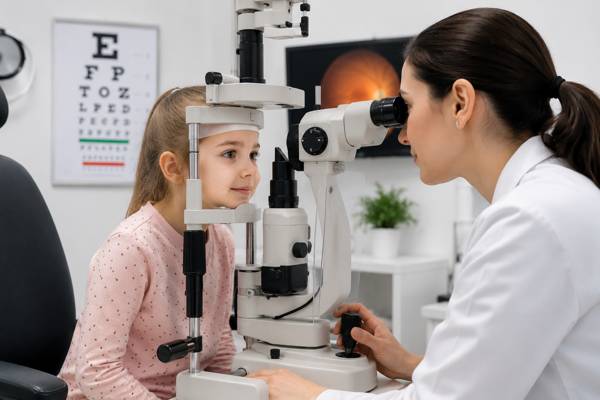
How is the diagnosis made?
- Refractive errors (myopia, hyperopia, astigmatism)
- Binocular coordination and depth perception (stereopsis)
- Eye movements (ocular motility) and the presence of strabismus or amblyopia
What is the treatment?
- The goal is to correct vision and ensure balanced visual input to both eyes.
- In cases of amblyopia, glasses may be combined with patching (occlusion) of the better-seeing eye.
- Parents and children need to learn when, and for how long, the glasses should be worn.
- Frames should be designed for children, flexible and durable, while lenses should be made of impact-resistant materials such as polycarbonate.
Eyeglasses for Controlling Childhood Myopia Progression
Safety: Designed with Children in Mind
Frames
- Flexible construction material, usually TR-90, acetate or titanium alloys
- Flexible or soft temple arms and a comfortable fit around the ears
- Well-positioned temple arms that distribute the weight evenly
- No sharp corners or protrusions
- Adjustable or silicone nose pads for a secure fit
Proper fit
Sunglasses for Children: Do Children Need Them?
Our approach by age group
At Athens Vision, we follow a practical, age-appropriate approach in line with the international guidelines of the American Academy of Pediatrics (AAP) and the American Academy of Ophthalmology (AAO):
- Infants under 6 months: The first line of protection is avoiding direct sun exposure through shade (stroller canopy, umbrella, shaded areas). Sunglasses are not necessary at this age and are often impractical.
- Toddlers and young children (6 months to 3 years): In our clinical judgment, a wide-brimmed hat (3 inches / 7.5 cm brim) is a fully acceptable form of protection. At this age, children often reject sunglasses, lose them easily or chew on them, so a hat offers better real-world protection. When the child cooperates and tolerates them, sunglasses can be added as supplementary protection, especially in highly reflective environments (beach, snow, water).
- Preschool and school-age children (3 years and older): Sunglasses are clearly recommended as a daily habit, combined with a hat for complete protection of the face and the skin around the eyes.
How do we choose sunglasses for children?
When choosing sunglasses for children, the technical characteristics are just as important as for prescription glasses. The key specifications are:
- Certified 99–100% protection against UVA and UVB radiation. The label “UV400” or “100% UV protection” must be clearly stated. Cheap sunglasses without certification are worse than no sunglasses at all, because the dark tint causes the pupil to dilate without blocking UV radiation.
- Polycarbonate lenses (as in prescription glasses) for excellent impact and shatter resistance.
- Wraparound design that also covers the sides, preventing UV radiation from entering from the side.
- A flexible, durable frame with the same safety features as prescription glasses (TR-90, flexible hinges, rounded edges).
- For infants and toddlers, if sunglasses are chosen, an elastic strap around the head for a secure fit.
Important note: The darkness of the lens tint does not reflect the level of UV protection. A light-tinted lens can offer full UV400 protection, while a very dark lens without certification can be harmful. Likewise, polarization improves visual comfort by reducing glare but does not replace UV protection. The two features are independent, and both should be verified.
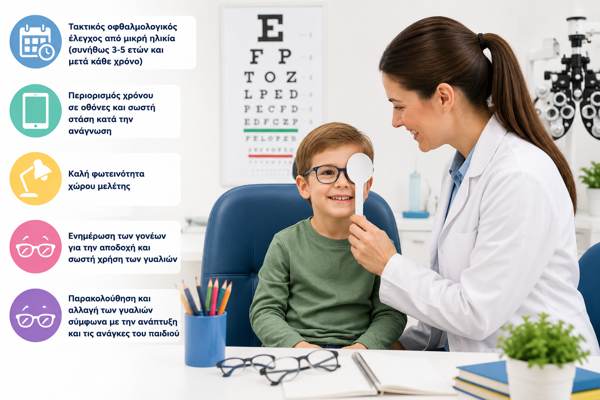
How can vision problems in children be prevented?
- Regular eye examinations from an early age
- Limiting screen time and maintaining good posture while reading
- Good lighting in the study area
- Encouraging parents to support their child’s acceptance and correct use of glasses
- Monitoring and updating the child’s glasses as the child grows and their needs change
A doctor who specializes in this condition

Anastasios Charonis
Specialties
Corneal Surgery – Transplants, Cataracts, Refractive Surgery, Pediatric Ophthalmology, Strabismus
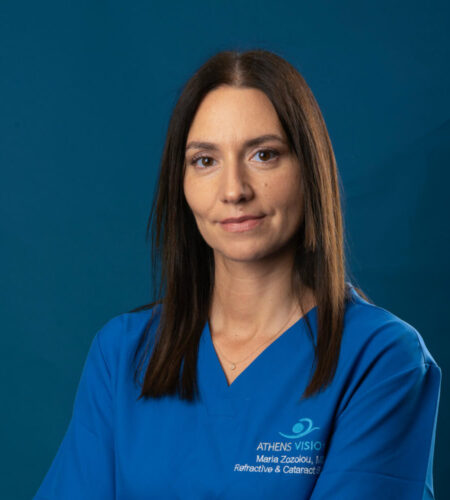
Maria Zozolou
Medical Degree, University of Athens Medical School; Ph.D., University of Athens Medical School; Board Certified by the European Board of Ophthalmology
Specialties
Pediatric Ophthalmology, Cataracts