

Laser Eye Surgery
The modern, safe, and permanent solution for clear vision without glasses or contact lenses.
Refractive laser surgery is currently the most advanced and widely used method for correcting myopia, astigmatism, hyperopia, and, in selected cases, presbyopia.
Over 20 million people worldwide have already chosen refractive laser surgery (excimer laser or femtosecond laser), regaining clear vision and freedom from glasses and contact lenses.
At Athens Vision, refractive surgery is a field where cutting-edge technology meets expertise. With years of experience and state-of-the-art equipment, we offer personalized solutions that are tailored to the anatomy, needs, and unique characteristics of each eye.
What does the laser correct?
Laser eye surgery corrects refractive errors, meaning conditions in which the eye does not focus light properly:
- Myopia
- Astigmatism
- Hyperopia
-
Presbyopia (in selected cases using specialized Presby-LASIK protocols)
Are you a suitable candidate?
-
you are at least (exceptions may be considered for candidates applying to military academies, law enforcement agencies, fire service academies, or similar institutions. In such cases, the decision is made on an individual basis, taking into account social and professional requirements, with parental consent required for patients under 18 years of age),
- your vision has been stable for at least one year,
- you have no corneal conditions (e.g., keratoconus), retinal conditions, or other serious eye disorders,
-
you are in good general health,
-
you are not currently pregnant or breastfeeding.
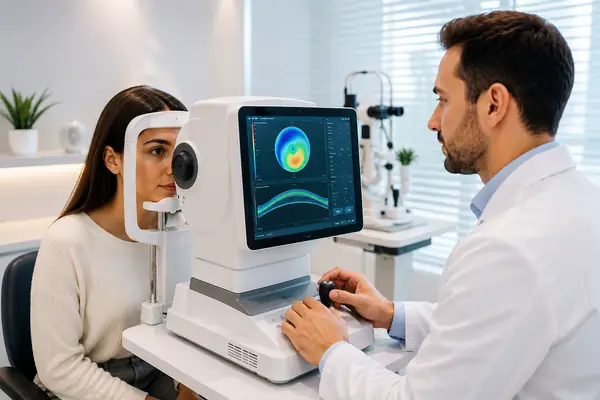
The Preoperative Examination — The Most Important Step
-
A comprehensive examination by optometrists and ophthalmologists
-
Visual acuity measurement and contrast sensitivity testing
-
Corneal topography/tomography using Dual Scheimpflug/OCT/Pyramidal Analyzer technology
-
Optical and ultrasonic pachymetry
-
Dynamic pupil diameter measurement using infrared systems under photopic and scotopic conditions
-
Goldmann applanation and dynamic contour tonometry (GAT/Pascal) with ORA for a comprehensive evaluation of intraocular pressure
-
Wavefront analysis (total and corneal)
-
Fundus examination after mydriasis
-
Cycloplegic refraction
Why is it so important?
-
the appropriate choice of surgical technique (PRK, Femto-LASIK, or SMILE Pro),
-
the identification of patients at risk of postoperative corneal ectasia or other corneal disorders,
-
the calculation of personalized ablation protocols,
- the development of a safe and personalized surgical plan.
Before the examination:
-
discontinue wearing soft contact lenses for one week (semi-rigid lenses for four weeks),
-
bring your current glasses and any previous prescriptions, if available,
- wear sunglasses after dilation.
Laser Surgery — Fast, Painless, Effective
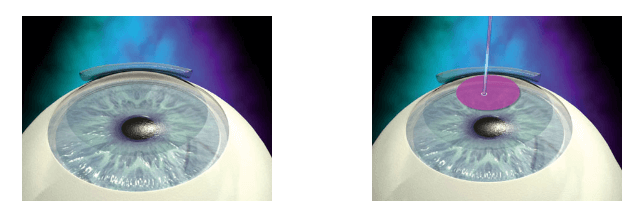
- avoid makeup, perfume, and hair gel,
- wear comfortable clothing,
- have a light meal,
- bring someone with you,
- if you feel anxious, a mild sedative may be administered.
Immediately after the procedure, your surgeon will perform a postoperative examination and provide you with detailed postoperative instructions.
PRK, Femto-LASIK, or SMILE Pro — Which method is best for you?
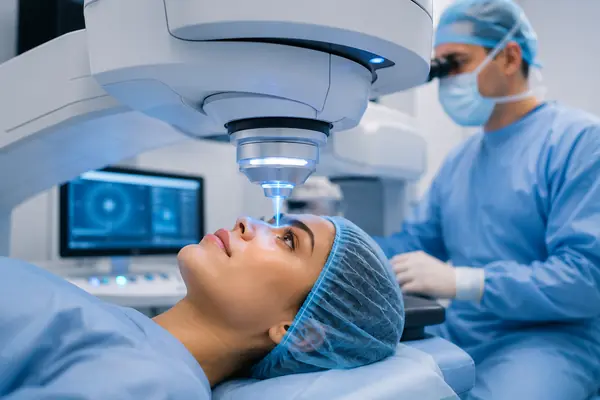
PRK / ASA (Photorefractive Keratectomy)
- No flap is created; therefore, none of the theoretical or documented risks associated with a flap (traumatic incision, epithelial ingrowth, intraoperative flap complications) are present.
- The method preserves the integrity of the deeper corneal layers, providing a theoretical biomechanical advantage and reducing the postoperative risk of corneal ectasia, particularly in eyes with borderline corneal thickness or topographic findings.
- It appears to provide better protection against postoperative dry eye compared to LASIK (known as “LASIK-related dry eye”).
Femto-LASIK (all-laser technique with a flap)
- Significantly faster recovery of vision compared to PRK/ASA—with the majority of patients returning to their daily routine as early as the first postoperative day.
- Virtually no postoperative pain, with minimal need for eye drops and far fewer accompanying symptoms during the first week (watery eyes, photophobia, blurred vision).
- With the use of a femtosecond laser instead of a mechanical microkeratome, the probability of corneal ectasia is now significantly lower than 1 in 3,000 eyes, as estimated in earlier studies from the 2000s—thanks to stricter preoperative screening, a smaller range of refractive correction, and the exceptional precision of the femtosecond laser flap.
- In cases of residual refractive error (on average 1–2% in Athens Vision data based on DATAGRAPH statistical analysis), retreatment can be performed early, 4–8 weeks after the initial procedure, since the flap can be lifted again. In PRK/ASA, retreatment usually requires a waiting period of at least 6 months.
SMILE Pro / Lenticule Extraction
- Minimally invasive technique: an incision of just 2–4 mm, compared to the more than 20-mm flap incision of Femto-LASIK. This preserves the biomechanical integrity and corneal innervation to a significantly greater extent.
- Greater biomechanical stability of the cornea compared to Femto-LASIK, with a theoretical benefit for patients with an active athletic lifestyle, where the risk of ocular trauma is increased.
- Virtually zero risk of flap complications (there is no flap to displace, tear, or develop epithelial ingrowth).
- Comfortable postoperative experience, with minimal pain and rapid return to normal activities—comparable to Femto-LASIK.
How is the appropriate method selected?
The choice of the appropriate method for laser eye surgery is tailored to each patient based on:
- Refractive Error
- The thickness and topography of the cornea
- The age
- The way of life
- The profession
- The desired recovery rate
- The presence of dry eye
- Sports Activities and the Risk of Injury
Our team will guide you in choosing the method that ensures the highest possible safety and long-term stability.
Laser Eye Surgery: Cost and Factors That Affect It
The cost of laser eye surgery can vary depending on the method chosen, the type and severity of the refractive error, the required preoperative evaluation, and each patient’s specific needs.
The final choice of method and the associated cost are determined following a detailed suitability assessment and a personalized evaluation by the ophthalmic surgeon.
Postoperative Follow-up
-
a check-up on the first postoperative day,
-
a check-up during the first postoperative week,
-
a check-up at three months.
-
do not rub your eyes,
-
avoid swimming,
-
avoid strenuous exercise, tanning beds, and dusty environments.
Results & Permanence
- there is appropriate preoperative assessment,
-
there are no future ocular or systemic conditions (e.g., cataracts, diabetes),
-
regular annual eye examinations are performed.

Possible Postoperative Discomforts — Usually Temporary
- Mild dry eyes
- Light sensitivity
- Mild glare or halos around lights at night
- Mild discomfort during the first few days (mainly after PRK)
Why choose Athens Vision?
Athens Vision is one of the most modern and well-organized ophthalmology centers in Europe. Its advantages include:
- A surgical team with over 20 years of experience
- Continuous active participation in Greek and international conferences, continuing medical education, and participation as speakers and trainers.
- Continuing Education
- Participation of physicians as speakers and instructors
- Latest-generation Excimer Laser
- High-Frequency Femtosecond Laser
- Comprehensive and personalized preoperative evaluation
- Fully controlled operating room conditions
- Ability to handle complex situations
Latest-generation Excimer Laser
-
the fastest ablation rate,
-
the most accurate eye tracker (5D/6D),
-
corneal thermal control,
- full wavefront- and topography-guided personalization.
High-Frequency Femtosecond Laser
-
creation of a micrometer-precision flap in Femto-LASIK,
-
creation of an intrastromal lenticule in SMILE Pro, operating at 2 MHz, with a lenticule creation time of under 10 seconds per eye,
-
treatment of a wide range of refractive errors (myopia, astigmatism, hyperopia) and corneal thicknesses.
Comprehensive, highly personalized preoperative evaluation
Fully controlled operating room conditions
-
controlled temperature and humidity,
-
HEPA filtration,
-
specially designed environments to ensure consistent results.
Ability to handle complex situations. Such as:
-
irregular astigmatism,
-
corneal transplantation,
-
previous ocular surgery,
-
corneal scars or trauma.