

SERVICES / MACULAR DEGENERATION
Age-Related Macular Degeneration (AMD)
The macula is a small, specialized area in the center of the retina responsible for sharp, detailed vision. It allows us to read, recognize faces, drive, use digital devices, and perform activities requiring precise central vision.
What is macular degeneration?
The macula is a small, specialized area in the center of the retina responsible for sharp, detailed vision. It allows us to read, recognize faces, drive, use digital devices, and perform activities requiring precise central vision.
When the macula is affected, central vision may become blurred, straight lines may appear distorted, and dark or missing areas may develop in the center of vision.
Although AMD can significantly affect central vision, peripheral vision usually remains preserved. Therefore, AMD rarely leads to complete blindness.
Although AMD can significantly affect central vision, peripheral vision usually remains preserved. Therefore, AMD rarely leads to complete blindness.
Normal vision

Vision with Age-Related Macular Degeneration

Causes and Forms of Age-Related Macular Degeneration
Age-related macular degeneration becomes more common with increasing age and results from a combination of genetic, environmental, and lifestyle factors.
Important risk factors include:
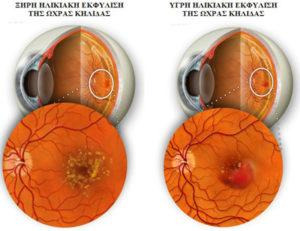
Dry (atrophic) AMD
This is the most common form of AMD.
It is characterized by the accumulation of deposits called drusen beneath the retina and gradual changes in the retinal layers.
In many patients, dry AMD progresses slowly over many years. In advanced stages, it may lead to loss of retinal cells, a condition known as geographic atrophy, causing significant central vision loss.
It is characterized by the accumulation of deposits called drusen beneath the retina and gradual changes in the retinal layers.
In many patients, dry AMD progresses slowly over many years. In advanced stages, it may lead to loss of retinal cells, a condition known as geographic atrophy, causing significant central vision loss.
Wet (neovascular) AMD
Wet AMD occurs when abnormal blood vessels grow underneath the retina.
These vessels are fragile and may leak fluid or blood, leading to distortion and often rapid deterioration of central vision.
Although less common than dry AMD, the wet form is responsible for a large proportion of severe vision loss related to AMD.
Early diagnosis and treatment are essential.
Although less common than dry AMD, the wet form is responsible for a large proportion of severe vision loss related to AMD.
Early diagnosis and treatment are essential.
Symptoms of Age-Related Macular Degeneration
Early AMD may cause few or no symptoms.
As the disease progresses, patients may notice:
- Blurred vision
- Difficulty reading
- Distortion of straight lines (metamorphopsia)
- Difficulty recognizing faces or performing detailed tasks
Peripheral vision usually remains unaffected.
Diagnosis of AMD
Diagnosis is based on a comprehensive ophthalmic examination and advanced retinal imaging.
- Amsler grid for checking for distortions
- Ophthalmoscopy for the detection of drusen and macular lesions
- Fluorescein or indocyanine fundus photography for the detection of new blood vessels
-
OCT (Optical Coherence Tomography)
Provides high-resolution images of the retinal layers and is essential for diagnosis, monitoring progression, and guiding treatment decisions.
Treatment of Age-Related Macular Degeneration
Lifestyle and nutritional support (AREDS2)
Large clinical studies have shown that specific antioxidant and mineral supplements (AREDS2 formulation) can reduce the risk of progression in selected patients with intermediate or high-risk AMD.
Supplements do not restore vision that has already been lost and are not suitable for everyone; an ophthalmologist determines whether they are appropriate.
Treatment for the wet (neovascular) form
Depending on the situation, the following may be applied:
- Laser: cauterization of abnormal blood vessels
- Photodynamic therapy: a combination of a photosensitizing drug and a low-energy laser
- Anti-VEGF injections: inhibit the growth of new blood vessels and often stabilize or improve central vision
Injections are currently the primary treatment for neovascular AMD.
Support for People with Low Vision
For patients with advanced vision loss, there are solutions available that improve their daily lives:
- Magnifying glasses
- Specialized digital systems and reading aids
- Customized devices and software for work and independence
Low-vision technologies enable many patients to maintain a high quality of life.
Home Monitoring – Amsler Grid
Regular self-monitoring with an Amsler grid can help detect new changes in central vision.
To use the grid:
Hold it approximately 30–40 cm away
Cover one eye at a time
Look directly at the central dot
Contact your ophthalmologist if new distortion, missing lines, or dark areas appear
New symptoms should always be evaluated promptly.
Hold it approximately 30–40 cm away
Cover one eye at a time
Look directly at the central dot
Contact your ophthalmologist if new distortion, missing lines, or dark areas appear
New symptoms should always be evaluated promptly.
Genetic Testing for AMD at Athens Vision
Specialized genetic evaluation for selected patients with age-related macular degeneration is available, whenever indicated.
Genetic testing may provide additional information about individual risk, particularly in patients with a strong family history, and may contribute to personalized counseling and monitoring strategies.
Your ophthalmologist will determine whether genetic evaluation is appropriate in your case.
Frequently Asked Questions
You should contact your doctor if you have age-related macular degeneration and experience:
- Painful eye inflammation and sensitivity to light (photophobia)
- A feeling of pressure behind your eye
- Myopsia or flashes of light
If you have age-related macular degeneration (AMD), you may want to ask your doctor:
- Why did I develop age-related macular degeneration?
- What type of age-related macular degeneration do I have?
- What is the best treatment for the type of age-related macular degeneration I have?
- What lifestyle changes can I make to protect my eyesight?
- Are there any risks or side effects associated with the treatment?
- Is my family at risk of developing age-related macular degeneration? If so, what steps can they take to protect their vision?
- Should I watch for signs of complications?
- Am I eligible to participate in a clinical trial?
Approximately 10% of patients develop the wet (neovascular) form, in which abnormal new blood vessels form beneath the macula, leaking fluid or blood and leading to a sudden and severe loss of central vision.
A doctor who specializes in this condition
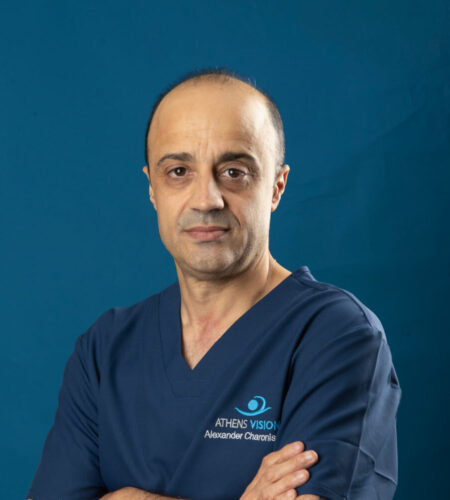
ALEXANDER CHARONIS
Ophthalmic Surgeon
Director of the Retina Department at AthensVision, Board Certified by the American and European Boards of Ophthalmology
Specialties: Vitreoretinal Surgery, Ocular Infections