
Strabismus
What is strabismus?
Strabismus is a condition in which the eyes are not properly aligned and the visual axes are not directed at the same point. This may manifest as a constant or intermittent deviation inward, outward, upward, or downward. Any suspicion that the eyes are misaligned, even temporarily, requires prompt evaluation by a specialized ophthalmologist, as early diagnosis is critical for preserving normal visual development.
Causes of Strabismus
Symptoms and Diagnosis
Symptoms of Strabismus
Diagnosis of Strabismus
What are the types of strabismus?
Strabismus Treatment
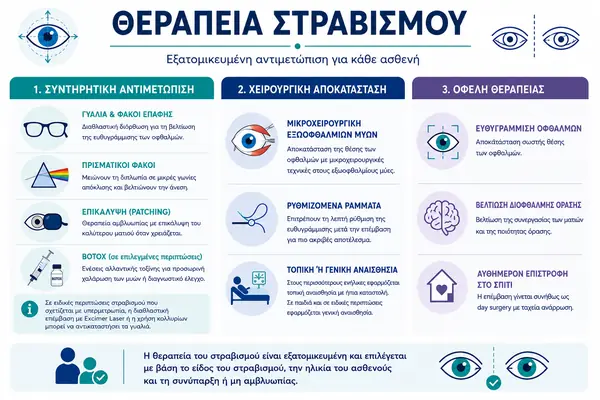
1. Conservative Approaches
-
Refractive correction with glasses or contact lenses, particularly in cases of strabismus associated with hyperopia (accommodative esotropia), where proper refractive correction alone can completely eliminate the deviation.
-
Prismatic lenses incorporated into eyeglasses, which optically shift the image and can relieve diplopia in patients with small, stable angles of deviation. They are often useful as a temporary measure before surgery or as a permanent solution in selected cases.
-
Patching of the better-seeing eye when amblyopia is present. Amblyopia should be treated first, as it influences both surgical planning and the final outcome.
-
Botulinum toxin (Botox) injected into selected extraocular muscles, producing temporary muscle relaxation. It may provide temporary ocular alignment (e.g., in sixth cranial nerve palsy) or be used to assess a patient’s tolerance to postoperative diplopia (Murray et al., Br J Ophthalmol, 2007).
-
In selected cases of accommodative strabismus associated with hyperopia, refractive surgery using an excimer laser or pharmacological treatment with eye drops may reduce or eliminate the need for glasses.
2. Surgical correction — the primary treatment option
Reconstructive, not cosmetic
(1) widening of the visual field (usually by 20–30 degrees) and improvement in depth perception, even when full stereoscopic vision is not restored;
(2) elimination of the compensatory abnormal head posture, which many patients adopt to avoid double vision;
(3) measurable improvement in quality of life, as demonstrated by the internationally validated Adult Strabismus-20 (AS-20) questionnaire in numerous published studies.
The professional, social, and psychological impact of correction is also significant, but it is not the sole reason for surgery.
3. Anesthesia in adults — the option of local anesthesia
- Avoidance of the risks and burden of general anesthesia—particularly important in elderly patients and those with cardiovascular, respiratory, or other systemic comorbidities.
- Faster recovery and same-day discharge (day surgery), without postoperative nausea or lethargy associated with general anesthesia.
- The ability to perform intraoperative reassessment of ocular alignment, with the patient in a sitting position if necessary, improving the accuracy of the final result.
- Compatibility with the adjustable suture technique (see next section), which allows fine adjustment of the result postoperatively.
4. Adjustable sutures
5. Postoperative diplopia — the actual picture based on the international literature
Data from classic studies
The findings are clear and reassuring: transient postoperative diplopia (which resolves spontaneously within six weeks) occurred in 9% of patients, while persistent diplopia lasting longer than six weeks occurred in only 0.8% (approximately 1 in 125 patients).
Efficacy and likelihood of a second surgery
Possible complications
Efficacy and likelihood of a second surgery
The majority of patients require only one surgery. Approximately 20% of patients, despite an initially successful outcome, may benefit from a second procedure—either because the strabismus was not fully corrected or because it recurred over time. The adjustable suture technique significantly reduces this rate. In patients with thyroid eye disease, the outcome is less predictable and is closely related to the clinical course of the disease.
Possible complications
The procedure is performed on the extraocular muscles, outside the eyeball, and therefore serious intraocular complications are extremely rare (endophthalmitis, retinal detachment related to the procedure: less than 1 in 3,500 procedures). The use of an operating microscope and microsurgical sutures further minimizes these risks. The most common temporary postoperative symptoms are tearing, mild redness, temporary eyelid drooping, and occasionally temporary double vision (see Section 5). Statistically, the most common “complication” is incomplete correction, which may require a second surgery.
Can strabismus be prevented?

Frequently Asked Questions
The procedure is performed as a day-case procedure: adult patients are discharged on the same day. Postoperative redness and tearing usually subside within one to three weeks. Most patients can return to their normal daily activities (office work or school for children) within one to seven days. Swimming (in pools or the sea) and strenuous physical activity should be avoided for two weeks, while contact sports should be avoided for four weeks. Driving is permitted as soon as any temporary diplopia (double vision) has resolved and the patient feels comfortable.
In the vast majority of cases, the result is stable. However, in approximately 20% of cases (as mentioned above), the strabismus may, over time, either remain partially undercorrected or recur, particularly in patients who have undergone multiple surgeries since childhood or in cases of strabismus associated with systemic diseases (e.g., thyroid eye disease, myasthenia gravis). In these cases, a second surgery may achieve the desired result. The adjustable suture technique significantly reduces the likelihood of needing additional surgery.
In some cases, particularly when the initial angle of deviation was large or the strabismus was chronic, a small residual angle of deviation may remain after surgery. If this is minor and the patient is asymptomatic and functions comfortably, no further intervention is required. If it causes symptoms (e.g., mild diplopia (double vision) or fatigue during prolonged reading), treatment is often non-surgical, involving prism correction incorporated into the patient’s glasses. A second surgical procedure is recommended only when there are clear functional or cosmetic indications.
Given that strabismus surgery in adults is internationally classified as reconstructive surgery—as discussed above, with documented functional benefits rather than purely cosmetic ones—it is generally covered by EOPYY and most private insurance companies. The exact coverage depends on the patient’s insurance policy. At our center, we provide all the documentation required for pre-authorization and reimbursement, based on the international guidelines of the AAO and ESA regarding the reconstructive nature of the procedure.
At Athens Vision, we offer specialized strabismus evaluations for adults and children. The preoperative evaluation includes measuring the angle of deviation in all positions of gaze, assessing binocular vision and stereoscopic function, a prism adaptation test (PAT), when indicated, and a thorough discussion of both conservative and surgical treatment options based on the patient’s individual clinical findings. The decision to proceed with surgery is made after a comprehensive consultation and mutual agreement between the patient and the surgeon.
A doctor who specializes in this condition