
Myopia
What is myopia?
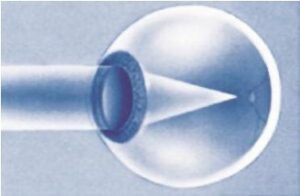
Myopia is a refractive error that affects nearly 50% of people of working age worldwide.
It is now preferred to use the term “refractive error” rather than “condition” when referring to refractive problems. The use of the terms “patient” and “disease” to describe our fellow human beings with refractive abnormalities is, in our opinion, somewhat arbitrary, given that refractive variations affect virtually all people at some point in life (e.g., presbyopia). The World Health Organization (WHO) has designated myopia as a pandemic, since in certain regions of the world it now affects 80–90% of young people under the age of 30 (e.g., in Singapore).
Myopia is a refractive error in which distance vision is particularly difficult, but with or without visual aids, in the majority of cases, the myopic person regains normal vision. Specifically, myopia occurs when visual stimuli do not focus on the surface of the retina. This is usually due to either elongation of the eyeball, increased curvature of the cornea, or, in very rare cases, structural problems with the eye’s crystalline lens. Myopia often coexists with other refractive errors, such as astigmatism and presbyopia.

Causes of myopia
Myopia is often hereditary, meaning it is genetically predetermined in our genome (DNA). Myopia development may have posed a significant advantage for human mankind according to the “antagonistic pleiotropy” principle. More in this article. However, environmental factors are equally important. Prolonged near work in enclosed spaces and the daily use of digital screens are statistically linked to the significant increase in the prevalence of myopia in modern societies. Myopia also occurs in patients who simultaneously have much more serious ophthalmic problems such as congenital glaucoma, congenital cataract, and optic neuropathy, but these are rare exceptions.
Stabilization of myopia
Myopia is usually acquired. In the majority of cases, it begins in the later grades of elementary school, although it can occur earlier or later. An exception is congenital myopia, in which the eye is often highly myopic as early as age 3. In these cases, however, the further progression of myopia is not dramatic and stabilizes relatively early. Myopia may stabilize at some point during adolescence, although in most cases there is a small but significant tendency for it to increase further as we grow older until we reach adulthood at 18–21 years of age.
Classification of Myopia
Myopia can be divided into simple or school myopia and progressive or malignant myopia — a form where the refractive error is usually at least -6 diopters and the eye exhibits internal changes not seen in simple myopia, such as myopic maculopathy. We also distinguish simple myopia in young adults (college myopia), which refers to individuals whose myopia shows a slight tendency to increase even during their third decade of life.
Symptoms of myopia
Myopia often appears in childhood and most frequently in the later grades of elementary school. Its main symptom is blurred distance vision. A parent may realize their child has myopia if they see the child watching TV from a very close distance, frequently rubbing their eyes, or blinking repeatedly in an effort to focus better. Also, if the child complains of not seeing the blackboard clearly or has frequent headaches, these are signs that should raise concern and prompt a visit to the ophthalmologist for an eye exam.
Adult patients with refractive errors, such as myopia, may experience frequent headaches and fatigue while driving or exercising, in addition to poor visual acuity. Very often, nearsighted individuals complain of “floaters” or myopsia, which occur due to liquefaction of the vitreous body.

Diagnosis of Myopia
The diagnosis of myopia must be made by a specialized ophthalmologist, who usually performs additional tests beyond a refraction test to rule out other eye conditions that may coexist with myopia. Myopes have approximately a 1 in 200 chance of developing retinal detachment during their lifetime. Furthermore, statistically, adults are more likely to develop cataracts and glaucoma in old age than “emmetropic” eyes—that is, eyes without myopia or other refractive errors.
Treatment of Myopia
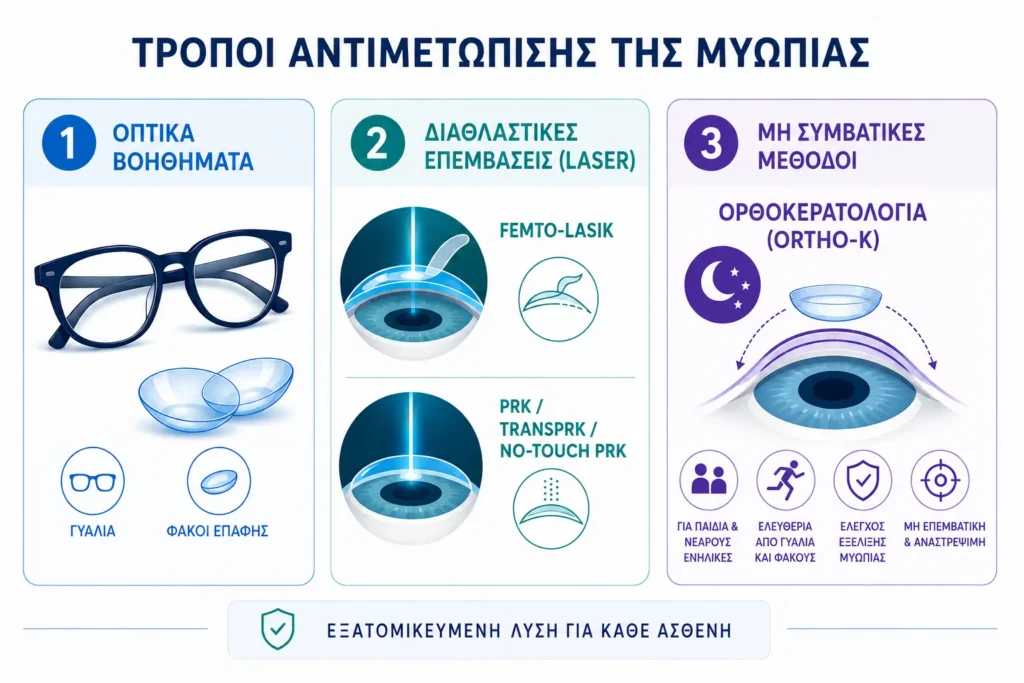
Myopia can be treated in three main ways:
1. Visual Aids
The simplest method is the use of glasses or contact lenses, which offer immediate and effective correction.
2. Refractive surgery (Laser)
At Athens Vision, we perform customized laser treatments for the permanent correction of myopia:
Femto-LASIK (Laser In Situ Keratomileusis):
Femto-LASIK (Laser In Situ Keratomileusis): A thin flap is created on the cornea, the laser is applied, and the flap is repositioned. The procedure takes just a few minutes, is painless, and the results are immediate.
PRK / TransPRK / No-Touch PRK:
The laser is applied to the surface of the cornea without creating a flap. Vision recovery is more gradual, but the technique is ideal for thin corneas.
3. Non-conventional methods
A modern technique with a well-documented scientific basis and many years of clinical experience at Athens Vision is:
Orthokeratology (Ortho-K): the use of special contact lenses worn during sleep that temporarily “reshape” the cornea.
Orthokeratology, which has been approved by the FDA since 2002, is based on the use of special gas-permeable semi-rigid lenses worn overnight, so that the cornea temporarily changes shape and provides better daytime vision without glasses or contact lenses.
Today, orthokeratology is considered one of the most effective methods for controlling the progression of childhood myopia (myopia control), with documented reductions in axial length elongation and the progression of myopia. Athens Vision is a leading center for orthokeratology in Greece and has been providing orthokeratology services continuously since 2014, boasting one of the largest case series in Greece and many years of experience in the personalized fitting and monitoring of lenses. The method is recommended for children (starting in elementary school!) and young adults with progressive myopia, as well as for patients who wish to be free from glasses and contact lenses during the day—for example, children and athletes involved in swimming, sailing, windsurfing, and water polo, as well as in select cases where the Excimer or Femto Laser (Smile, SmartSight, Silk) is not an option.
What are refractive (laser) surgeries for myopia?
At Athens Vision, we perform a wide variety of procedures tailored to each patient’s needs. Refractive surgery—laser procedures—is no longer a risky alternative with questionable effectiveness and safety. In the third decade of the 21st century, refractive surgery has established itself as a permanent, safe, and cost-effective solution for nearly all refractive errors (myopia, astigmatism, hyperopia, presbyopia). The millions of patients who have been freed from their glasses through laser surgery are tangible proof of the value of refractive surgery in treating myopia, astigmatism, hyperopia, and presbyopia.
Read more here.
Myopia Prevention
Myopia can be corrected with glasses, contact lenses, or refractive surgery; however, efforts to slow its progression are of significant interest, particularly in children and young adults. Modern ophthalmology now recognizes myopia as a progressively developing condition, the progression of which can be substantially slowed through a combination of environmental interventions and specialized optical control methods (myopia control).
Outdoor activities — the most powerful preventive intervention
Systematic exposure to natural light is the most scientifically proven method for preventing the onset and slowing the progression of childhood myopia. Multicenter studies (particularly from Australia, Singapore, and Taiwan) have shown that children who spend at least 2 hours a day on outdoor activities have a significantly reduced risk of developing myopia and a slower progression when it is already present. The main mechanism appears to be linked to high outdoor light intensity (10,000–100,000 lux versus 200–500 lux indoors), which stimulates the release of dopamine from the retina — a neurotransmitter that inhibits pathological elongation of the ocular axis.
At Athens Vision, we strongly recommend that all parents encourage their children to spend at least 90–120 minutes daily on outdoor activities, regardless of the type (sports, recreation, school breaks). This recommendation applies equally to children without myopia (as primary prevention) and to children with established myopia (as secondary prevention against progression).
Healthy visual habits
Prolonged close-up work (reading, screens, cell phones, tablets) is statistically linked to an increase in myopia. Adopting organized visual habits can make a significant difference: frequent breaks following the 20–20–20 rule (every 20 minutes of close-up work, take a 20-second break looking into the distance at 20 feet / approximately 6 meters), proper reading distance (at least 30–40 cm), adequate task lighting, and limiting total screen time for children under 10 years of age.
Modern Methods of Myopia Control — Peripheral Defocus Technology
In recent years, the field of optometry has developed a new generation of glasses and contact lenses designed exclusively to control the progression of childhood myopia. Unlike standard myopia glasses—which correct only central vision but allow the peripheral image to focus behind the retina (hyperopic peripheral defocus), a stimulus that, in animal models, promotes eye elongation—these modern lenses introduce a deliberate myopic peripheral defocus, which inhibits the biological growth signal. Many randomized controlled trials (RCTs) have documented a 50–67% reduction in the progression of myopia compared to conventional corrective methods. At Athens Vision, we apply the following certified technologies in a personalized manner:
- Hoya MiYOSMART (D.I.M.S. Technology): eyeglasses featuring Defocus Incorporated Multiple Segments technology—a central optical correction zone surrounded by hundreds of small segments of myopic defocus (+3.50 D). This is the first technology of its kind with published two-year and six-year clinical data from the Hong Kong Polytechnic University, documenting a >50% slowdown in myopia progression and a ~50% slowdown in axial length elongation.
- Essilor Stellest (H.A.L.T. Technology): eyeglasses featuring Highly Aspherical Lenslet Target (H.A.L.T.) technology — 1,021 aspheric micro-lenses arranged in 11 concentric rings, creating a continuous volume of myopic defocus in front of the peripheral retina. Long-term clinical data show an average progression slowdown of >50% when worn for at least 12 hours daily.
- ZEISS MyoCare: eyeglasses featuring Cylindrical Annular Refractive Elements (C.A.R.E.) technology — alternating focus and support rings that provide a continuous optical signal to control eye elongation. It offers specialized versions (MyoCare and MyoCare S) tailored to the child’s age and activity level.
The selection of the appropriate technology is personalized following a comprehensive ophthalmic and refractive evaluation, while effectiveness is objectively monitored through regular measurements of axial length.
Pharmacological Approach
Clinical studies are being conducted worldwide with low-dose atropine formulations (0.01–0.05%), which have shown significant effectiveness in slowing the progression of childhood myopia. Currently, there is no officially approved medication for the prevention of myopia in Greece; however, low-dose atropine can be prescribed as part of personalized treatment at strictly selected pharmacies capable of compounding “galenic” medications in accordance with current European standards. Athens Vision has been recommending and using this technique since 2012. It also organized the first myopia prevention workshop in Greece at the Intraocular Lenses and Refractive Surgery Conference in 2014. (Anast. K. Charonis)
Timely ophthalmological monitoring and personalized guidance for both children and adults are the most effective means of maintaining stable and healthy vision. At Athens Vision, we offer a comprehensive myopia management program that combines monitoring of the axial length, personalized selection of peripheral defocus technology, the use of low-dose atropine, orthokeratology, and guidance on outdoor activities and healthy visual habits.
Frequently Asked Questions
We can help you decide whether correcting your myopia, astigmatism, hyperopia, or presbyopia is the best option for you.
In general:
-
You must be at least 18 years of age (an exception is made for procedures performed to gain admission to a military academy/ security forces/fire department/naval academies, etc. In such cases, the decision to perform the procedure is individualized, and social and professional factors are taken into account in the final decision to perform (or not) of an invasive procedure before reaching the age of legal majority, which requires parental consent)
-
to be in good overall health,
-
stable vision over the past year
-
You must not have any chronic conditions affecting the cornea, the retina, or other eye diseases
-
If you are a woman, this treatment is contraindicated during pregnancy and while breastfeeding.
Of course, to determine whether you are a suitable candidate for myopia correction, you will need to undergo a comprehensive preoperative evaluation, which includes a series of tests:
-
Full History
-
Complete Refractive Examination
-
Goldmann Tonometry
-
Comprehensive Fundus Examination (Optic Nerve, Macula, Periphery)
-
Refraction (Visual Acuity Test)
-
Automated Keratometry
-
Ammeter
-
Examination Under a Slit Lamp
-
Measurement of the Mesoptic Diameter of the Pupil
-
Eye Movement
-
Circular Refraction
-
Tear Film Measurement (Schirmer Test)
-
Corneal Topography
-
Topography of the Anterior and Posterior Corneal Surfaces – Scheimpflug
-
Pachymetry
-
Measurement of Ocular Inertia & IOP with the Ocular Response Analyzer (Assessment of the mechanical properties of the cornea)
Yes, it is possible. This is especially true during periods of rapid growth in preadolescence and adolescence, when your body is growing quickly. By the age of 20, myopia usually stabilizes. Myopia can also be diagnosed in adults. When this happens, it’s usually due to eye strain or a medical condition, such as diabetes or cataracts.
You may experience eye strain if you spend too much time on activities that require focusing at close range, such as reading or working on a computer. Eye care specialists believe that your eyes’ focusing muscles can “lock” into the “near-focus position” due to overuse in this way.
If you are an adult and experience sudden myopia, myopic spots (spots appearing in your field of vision), flashes of light or shadows, or sudden vision loss in one eye, contact an ophthalmologist immediately to rule out a more serious condition. Ophthalmologists believe that your eyes’ focusing muscles may “lock” into the “near-focus position” due to overuse in this manner.
The cost varies depending on the technique chosen, as well as on whether you are a suitable candidate for it. The exact price is determined after a comprehensive eye exam, which determines which method is best suited to the specific condition of each eye.
Doctors who specialize in this condition

ANASTASIOS CHARONIS
Ph.D. from the University of Freiburg, Board Certified by the American and European Boards of Ophthalmology
MARIA ZOZOLOU

GEORGIA KOSTI