
What is hyperopia?
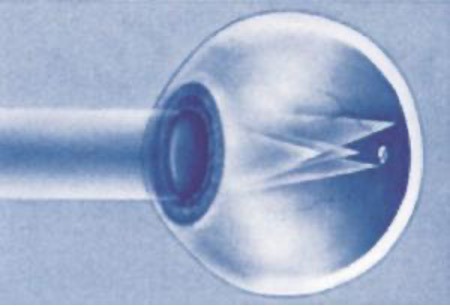
Hyperopia is a refractive error in which light focuses behind the retina, primarily affecting near vision and, in higher degrees, distance vision as well. This occurs when the axial length of the eye is shorter than normal or when the cornea or crystalline lens is flatter than average.
The normal eye is usually hyperopic at birth. This often decreases during school years and may disappear entirely by adolescence, as the eye grows in axial length (a process known as emmetropization).
Causes of hyperopia
Hyperopia is caused by factors that affect the structure and refractive power of the eye. The most frequent cause is a shorter-than-average axial length of the eyeball. Less common causes include a flatter cornea or crystalline lens, genetic predisposition, congenital anatomical variations, or age-related changes that affect the lens’s ability to focus properly. In many cases, hyperopia is latent and becomes symptomatic later in life.
Symptoms of hyperopia
Hyperopia can cause a range of problems that primarily affect near vision, while distance vision may also be affected, particularly in higher degrees of hyperopia. Patients often experience blurred near vision, difficulty concentrating when reading or working on a screen, as well as fatigue or headaches after tasks requiring close attention. Many farsighted people describe a burning sensation, heaviness, or blurriness, especially when they are not wearing corrective glasses. In some cases, squinting (narrowing the eyelids) is required for clear vision, which leads to even greater eye strain.

Hyperopia in Childhood
At birth, the normal eye is hyperopic, a condition that increases until the early school years and, according to classical theory, decreases and often resolves completely during adolescence thanks to the child’s eye’s strong accommodative ability.
In children, however, hyperopia can affect the development of binocular vision and lead to strabismus or amblyopia (lazy eye) if left untreated. For this reason, the ophthalmologist usually recommends glasses at a young age to ensure the proper development of the visual system.
Hyperopia in Adolescents and Adults
During adolescence, the lens’s strong accommodative power allows most hyperopic individuals to see clearly without corrective glasses. Over the years, however, this ability diminishes.
Thus, latent hyperopia becomes symptomatic (clinically manifest hyperopia), and the patient begins to experience headaches, fatigue, or blurred vision after close work. If they do not wear glasses, blurred vision may occur even when looking at distant objects.
Clinically, hyperopes often need to change their prescription, and it is not at all uncommon for hyperopia to increase until around the age of 55.
Diagnosis of Hyperopia
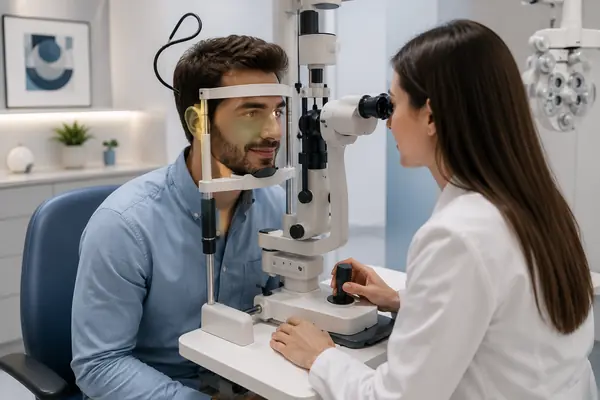
Hyperopia is diagnosed by a specialized ophthalmologist through a comprehensive eye examination. In addition to a refraction test, supplementary examinations are often required to rule out other conditions or associated ocular abnormalities. This evaluation is particularly important in children, as early diagnosis contributes to the normal development of vision and prevents problems such as strabismus or reduced vision in one eye.
Treatment of Hyperopia
At Athens Vision, we treat hyperopia with a full range of modern methods, the selection of which is personalized based on age, the degree of hyperopia, the quality of the cornea, and the presence or absence of presbyopia.
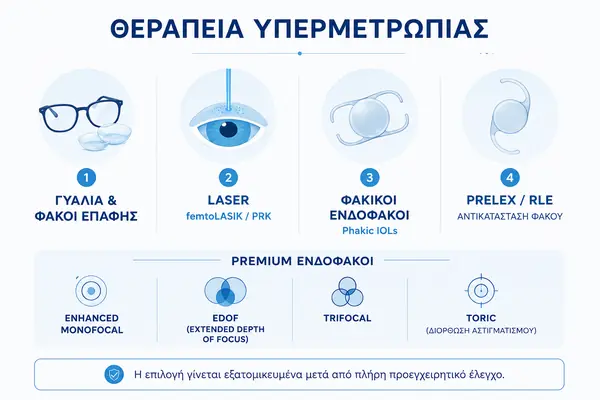
- Glasses and Contact Lenses
Hyperopia is effectively treated with corrective glasses, contact lenses, or refractive surgery. Glasses and contact lenses are an immediate and safe solution, offering clear vision at all distances. Contact lenses are an option for those who desire greater comfort or do not want to wear glasses; however, they require proper hygiene and regular checkups.
- Laser Refractive Surgery (femtoLASIK / PRK)
For patients who meet the appropriate criteria, hyperopia can be permanently corrected through refractive surgery using an excimer laser (LASIK and, less commonly, PRK). This technique increases the curvature of the central cornea, thereby increasing its refractive power so that light focuses precisely on the retina. The method is primarily indicated for low to moderate hyperopia (up to approximately +4.00 to +5.00 diopters), in relatively young or middle-aged patients with stable refraction and sufficient corneal thickness and quality.
- Phakic Intraocular Lenses (Phakic IOLs)
In young patients with high hyperopia or in cases where the shape of the cornea precludes laser surgery, the implantation of a phakic intraocular lens may be performed. This is a specialized intraocular lens that is placed inside the eye (usually in the posterior chamber, in front of the natural crystalline lens) without removing the crystalline lens. The procedure offers excellent visual quality and is reversible, while preserving the eye’s accommodative ability in younger patients. This method (EVO Visian ICL, V4c, STAAR Surgical) is primarily intended for patients with high myopia/myopic astigmatism, but in exceptional cases and under specific conditions, it may also be applicable to patients with hyperopia.
- Refractive Lens Exchange — PRELEX / Refractive Lens Exchange (RLE)
Refractive Lens Exchange (RLE), widely known as PRELEX (PResbyopic Lens EXchange) or as clear/pre-cataract lens extraction (Clear / Near-Clear Lens Extraction), is the procedure of choice for correcting hyperopia in patients aged approximately 50 years and older, particularly when presbyopia or early opacities of the crystalline lens are present.
Technically, it is the same surgical procedure as that for cataracts—a 2.2 mm incision, ultrasonic phacoemulsification, and implantation of a customized intraocular lens—with the difference that the natural lens is removed prophylactically, before it progresses to a functionally significant cataract. For hyperopia, PRELEX offers significant advantages over laser surgery: it is particularly effective for high degrees of hyperopia (beyond +4.00 to +5.00 diopters), it is not dependent on the thickness or geometry of the cornea, and it simultaneously addresses presbyopia through the selection of a premium intraocular lens. Furthermore, it eliminates the future need for cataract surgery, since the implanted intraocular lens cannot develop a cataract.
Categories of Premium Intraocular Lenses (IOLs)
At Athens Vision, we specialize in refractive lens surgery using the latest generation of premium intraocular lenses. The selection of the appropriate intraocular lens is personalized, based on the anatomy of the eye, the patient’s daily visual needs, and their priorities. The main categories include:
Enhanced monofocal: provide excellent distance vision and an extended intermediate range, with minimal visual artifacts.
Extended Depth of Focus (EDOF): create a continuous focal zone from distance to intermediate range, with reduced visual disturbances compared to multifocal lenses.
Trifocal: provide three distinct focal zones (distance, intermediate, near), offering the greatest possible independence from glasses for patients who desire complete visual freedom.
Toric: incorporate correction for corneal astigmatism and are available in all of the above categories (toric monofocal, toric EDOF, toric trifocal), correcting both hyperopia and astigmatism in a single procedure.
The choice of the appropriate treatment depends on age, the degree of hyperopia, the presence or absence of presbyopia, the condition of the crystalline lens, and the quality of vision the patient desires. At Athens Vision, following a comprehensive preoperative examination, the ophthalmologist recommends the most appropriate personalized treatment plan, prioritizing safety and optimal visual outcomes.
Prevention of Hyperopia
Hyperopia cannot be prevented, but early diagnosis and proper monitoring help avoid complications. Regular eye exams are essential for school-age children and adults over 40. Proper ergonomics when working with computer screens, adequate rest for the eyes, and educating parents and teachers about the need for vision screening in children help with the early identification of problems.
At the same time, screening for latent hyperopia in children can prevent the development of strabismus or amblyopia, while monitoring in adults ensures that any symptomatic hyperopia is treated promptly and does not affect daily functioning.
Laser Treatment for Hyperopia
At Athens Vision, we perform a variety of procedures tailored to each patient’s needs. Refractive surgery—laser procedures—is no longer a risky alternative with uncertain effectiveness and safety. In the third decade of the 21st century, refractive surgery has established itself as a permanent, safe, and cost-effective solution for nearly all refractive errors (myopia, astigmatism, hyperopia, presbyopia). The millions of patients who have been freed from their glasses through laser surgery are tangible proof of the value of refractive surgery in treating myopia, astigmatism, hyperopia, and presbyopia.
Frequently Asked Questions
We can help you decide whether correcting your myopia, astigmatism, hyperopia, or presbyopia is the best option for you.
In general:
-
You must be at least 18 years of age (an exception is made for procedures performed to gain admission to a military academy/ security forces/fire department/naval academies, etc. In such cases, the decision to perform the procedure is individualized, and social and professional factors are taken into account in the final decision to perform (or not) of an invasive procedure before reaching the age of legal majority, which requires parental consent)
-
to be in good overall health,
-
stable vision over the past year
-
You must not have any chronic conditions affecting the cornea, the retina, or other eye diseases
-
If you are a woman, this treatment is contraindicated during pregnancy and while breastfeeding.
Of course, to determine whether you are a suitable candidate for myopia correction, you will need to undergo a comprehensive preoperative evaluation, which includes a series of tests:
-
Full History
-
Complete Refractive Examination
-
Goldmann Tonometry
-
Comprehensive Fundus Examination (Optic Nerve, Macula, Periphery)
-
Refraction (Visual Acuity Test)
-
Automated Keratometry
-
Ammeter
-
Examination Under a Slit Lamp
-
Measurement of the Mesoptic Diameter of the Pupil
-
Eye Movement
-
Circular Refraction
-
Tear Film Measurement (Schirmer Test)
-
Corneal Topography
-
Topography of the Anterior and Posterior Corneal Surfaces – Scheimpflug
-
Pachymetry
-
Measurement of Ocular Inertia & IOP with the Ocular Response Analyzer (Assessment of the mechanical properties of the cornea)
The cost varies depending on the technique chosen, as well as on whether you are a suitable candidate for it. The exact price is determined after a comprehensive eye exam, which determines which method is best suited to the specific condition of each eye.
Doctors who specialize in this condition

ANASTASIOS CHARONIS

MARIA ZOZOLOU

GEORGIA KOSTI