
Astigmatism
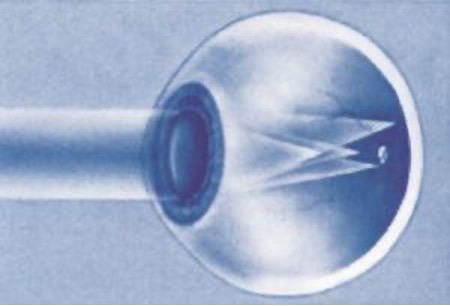
Astigmatism is most commonly of corneal origin. When the curvature of the cornea is not uniform across its various meridians, the image of an object cannot be focused as a single point on the retina.
What is astigmatism?
Astigmatism is most commonly of corneal origin. When the curvature of the cornea is not uniform across its various meridians, the image of an object cannot be focused as a single point on the retina.
This refractive condition is called astigmatism (corneal astigmatism). More rarely, however, astigmatism is caused by an irregular crystalline lens located behind the iris of the eye (lenticular astigmatism). Astigmatism can coexist with both myopia and hyperopia.
Causes of Astigmatism
Astigmatism is usually congenital, meaning it is present from birth, and is caused by an irregular curvature of the cornea or the lens. It is often linked to hereditary factors, as it is observed more frequently in individuals with a family history of refractive errors.
In fewer cases, astigmatism may develop secondarily following corneal injuries, after eye surgeries, or due to conditions such as keratoconus, which significantly alters the surface and curvature of the cornea. In these cases, the distortion is often more pronounced and requires specialized treatment.
Symptoms of Astigmatism
The primary symptom of astigmatism is blurred vision. Additionally, it very often causes eye strain, which manifests as fatigue, dizziness, and redness when someone reads for a long time or uses a computer.
Symptoms usually worsen when trying to read in dim lighting. A classic symptom of astigmatism is evening headaches.

Diagnosis of Astigmatism
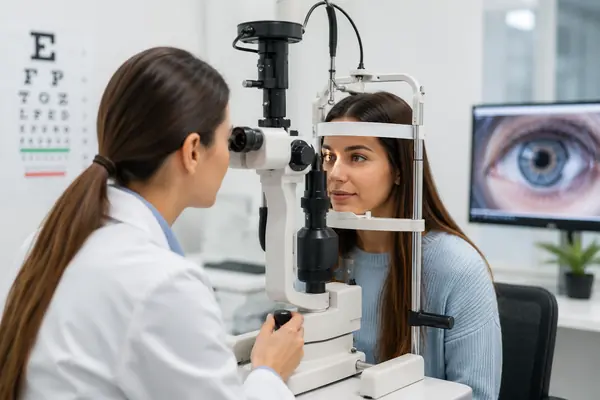
Astigmatism is diagnosed during an eye exam that includes a refraction test. In most cases, astigmatism coexists with other refractive errors such as myopia, hyperopia, and presbyopia (depending on the patient’s age). Although the diagnosis of astigmatism is clinical, a skilled clinician can obtain qualitative data using the technique of retinoscopy. Modern ophthalmology requires the use of highly specialized diagnostic equipment. This equipment, ranging from simple corneal topography to Scheimpflug analyzers, anterior-segment OCT, and pyramidal wavefront aberrometry, enables not only the diagnosis of abnormalities but also the monitoring of the stability of corneal parameters over time. (This applies in practice to irregular astigmatism, keratoconus, pellucid marginal degeneration, as well as the monitoring and treatment of corneal injuries.)
Astigmatism Treatment
Astigmatism treatment is tailored to the specific type (regular, irregular, with or against the rule, orthogonal, oblique, symmetrical, etc.). For regular, orthogonal, symmetric astigmatism, when it is not very severe, the most common solution is eyeglasses.
Contact lenses can often be used as well, though not always standard-design contact lenses. In difficult cases of large oblique and irregular astigmatism, the use of custom-fit contact lenses is necessary to achieve optimal visual performance. In many cases, the use of an excimer laser is also indicated for the treatment of astigmatism. In the case of significant irregular astigmatism because of keratoconus the initial treatment is corneal crosslinking and or/or CAIRS. For more info regarding corneal crosslinking (CXL) click here. For more information regarding CAIRS click here.
Prevention of Astigmatism
There is no effective way to prevent congenital astigmatism, as it is a natural characteristic of the cornea or lens.
However, regular eye exams are recommended so that the refractive error can be detected early and corrected appropriately (with glasses, contact lenses, or laser and corneal cross-linking techniques when necessary).
Early diagnosis helps prevent headaches, fatigue, and a decrease in visual acuity.
Laser Treatment for Astigmatism
Regarding laser treatment for astigmatism, the use of an excimer laser is a very strong indication, provided, of course, that the safety requirements for using an excimer laser on the specific patient are met. The 8th-generation Excimer laser can very precisely determine the axis of astigmatism preoperatively and ensure the correct application of the laser despite intraoperative eye rotation (7D eye tracker).
Frequently Asked Questions
We can help you decide whether correcting your myopia, astigmatism, hyperopia, or presbyopia is the best option for you.
In general:
-
You must be at least 18 years of age (an exception is made for procedures performed to gain admission to a military academy/ security forces/fire department/naval academies, etc. In such cases, the decision to perform the procedure is individualized, and social and professional factors are taken into account in the final decision to perform (or not) of an invasive procedure before reaching the age of legal majority, which requires parental consent)
-
to be in good overall health,
-
stable vision over the past year
-
You must not have any chronic conditions affecting the cornea, the retina, or other eye diseases
-
If you are a woman, this treatment is contraindicated during pregnancy and while breastfeeding.
Of course, to determine whether you are a suitable candidate for myopia correction, you will need to undergo a comprehensive preoperative evaluation, which includes a series of tests:
-
Full History
-
Complete Refractive Examination
-
Goldmann Tonometry
-
Comprehensive Fundus Examination (Optic Nerve, Macula, Periphery)
-
Refraction (Visual Acuity Test)
-
Automated Keratometry
-
Ammeter
-
Examination Under a Slit Lamp
-
Measurement of the Mesoptic Diameter of the Pupil
-
Eye Movement
-
Circular Refraction
-
Tear Film Measurement (Schirmer Test)
-
Corneal Topography
-
Topography of the Anterior and Posterior Corneal Surfaces – Scheimpflug
-
Pachymetry
-
Measurement of Ocular Inertia & IOP with the Ocular Response Analyzer (Assessment of the mechanical properties of the cornea)
The cost varies depending on the technique chosen, as well as on whether you are a suitable candidate for it. The exact price is determined after a comprehensive eye exam, which determines which method is best suited to the specific condition of each eye.
Doctors who specialize in this condition

ANASTASIOS CHARONIS
Maria Zozolou

GEORGIA KOSTI